Product Architecture
Your Hiring Process Has More Users Than You Think
Most hiring processes are designed around the one person who gets the job. But everyone else leaves with an experience that can influence who applies next. What happens when we look at hiring as a service designed for everyone who participates in it?
Andrei Stanescu


I've been looking for a new role for a while now, which inevitably means I've applied for quite a few jobs and, unsurprisingly, I've also been rejected from quite a few.
I'm not angry about the rejections. They're frustrating, of course, but rejection is simply part of the nature of any competition. Sometimes you win, sometimes you lose. Being angry about that would be a bit like being upset that water is wet. It's not something going wrong; it's simply a consequence of how the thing works. There are other people competing for the same roles, companies have every right to choose whoever they believe is the best fit, and the fact that I think I would be good at a job doesn't mean someone else wouldn't be better.
Sometimes I understand the decision, sometimes I don't, and there have certainly been occasions where I thought I was a much stronger fit than the outcome suggested. But that's not really what has stayed with me. What has started bothering me isn't the rejection itself. It's the process around it.
After going through enough hiring processes, I've started noticing the same patterns again and again. I've seen interviews scheduled weeks apart, long exercises given with surprisingly little context, roles that seem to shift while the process is already underway, conversations that don't appear to lead anywhere, and generic rejection messages arriving after candidates have invested hours of their own time. None of these things is particularly outrageous on its own, and I don't think they're necessarily signs of bad recruiters or bad hiring managers either. In fact, I suspect that's part of the problem.
Recruiters have a job to do, hiring managers have limited time, companies may have hundreds of applications to process, and everyone involved internally is trying to move candidates through a system efficiently enough to eventually fill a position. They can all be doing their jobs perfectly reasonably while the experience produced by that system is still not particularly good for the person on the other side of it.
I'm a designer, so after a while I started thinking about hiring less as a candidate going through it and more as a service someone had designed. I also spent part of my career working in background screening, which means the candidate side isn't the only perspective I've had on this. I've worked around another part of the machinery that sits behind hiring, where employers, candidates, screening providers and other parties all have different responsibilities, information and expectations, but are still contributing to what the candidate experiences as one hiring journey. That probably influences how I look at the problem now. What appears internally as a series of separate processes, teams and responsibilities doesn't necessarily feel separate to the person going through them.
To them, it's all part of their experience with the company. And viewed that way, there are some things about hiring that feel slightly strange.
We design hiring around the one person who gets hired
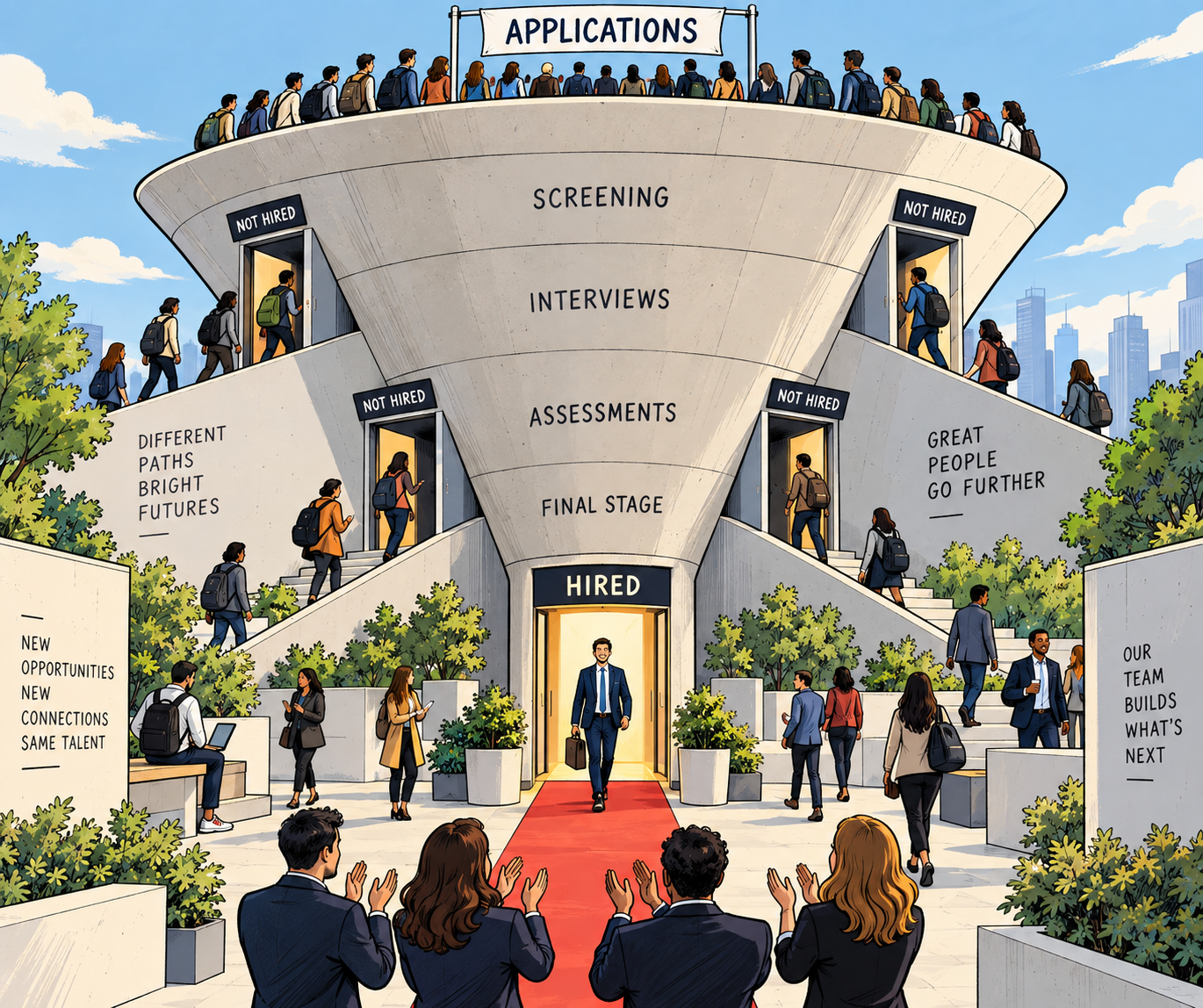
Most hiring processes have a very obvious measure of success: somebody gets the job. A role opens, applications come in, candidates are screened, a smaller number are interviewed, perhaps two or three reach the final stage, one receives an offer and eventually accepts it. The vacancy is filled and, from an operational perspective, the process has successfully done what it was created to do. But if I looked at almost any other service that way, I'd probably consider my analysis incomplete.
Imagine 100 people entering a service and only one of them reaching its intended destination. I wouldn't spend most of my time studying that one successful journey and conclude that the service worked because somebody made it through. I'd want to understand what happened to the other 99, where they left, what they experienced before leaving and, importantly, what they thought about the service afterwards. Hiring is unusual because those unsuccessful journeys aren't exceptional cases that occasionally happen when something goes wrong. They are the expected outcome for almost everybody who participates.
If 100 people apply for a job, perhaps 20 receive an initial screening call, six reach interviews, two become finalists and one gets hired. From the perspective of a recruitment funnel, that's perfectly normal. From the perspective of service design, however, there were 100 people who had some form of interaction with the organisation and 99 of those interactions ended without the person receiving the thing they originally came for. Of course, those experiences aren't remotely equal. Someone who uploaded a CV and received an automated rejection the following morning hasn't invested very much in the process, while someone who researched the company, rearranged their working day, prepared their portfolio, completed an exercise and spent several hours meeting different members of the team has invested considerably more.
Operationally, though, both eventually end up in roughly the same state: not hired.
That makes me wonder whether we've been treating the wrong journey as the main one. If rejection is the outcome experienced by the overwhelming majority of people using a hiring service, then perhaps the rejected-candidate experience isn't an edge case we should tidy up after designing everything else. It may actually be one of the most important parts of the service to design properly.
The successful candidate is actually the exception
There's an interesting contradiction here because the person the hiring process is ultimately designed around is the one person who never experiences its most common outcome. The successful candidate doesn't get rejected. We quite rightly care about their experience. We want them to understand the company, we want interviews to happen efficiently, we want the role to feel attractive, we want the offer to be competitive and, once we've decided they're the person we want, we become very interested in whether they'll accept. But in service design, the people who don't successfully complete a journey are often the people I would want to understand most.
If most customers successfully complete a checkout but a significant minority abandon it, I don't learn much by repeatedly studying the people who bought something. I start looking at the people who didn't. Where did they struggle? Was something unclear? Did we ask them to do something unnecessary? Did their expectations stop matching what the service was giving them? Was important information available to the organisation but not to them? Was the amount of effort we asked for proportionate to the likelihood of a successful outcome? We don't investigate those things because unsuccessful users deserve to be made happy about not getting what they wanted. We investigate them because unsuccessful journeys often expose things about the service that successful journeys don't.
I don't see why hiring should be fundamentally different. The candidate your hiring process is designed around is the candidate least likely to experience its most common outcome.
A candidate's time isn't less valuable because the company isn't paying for it
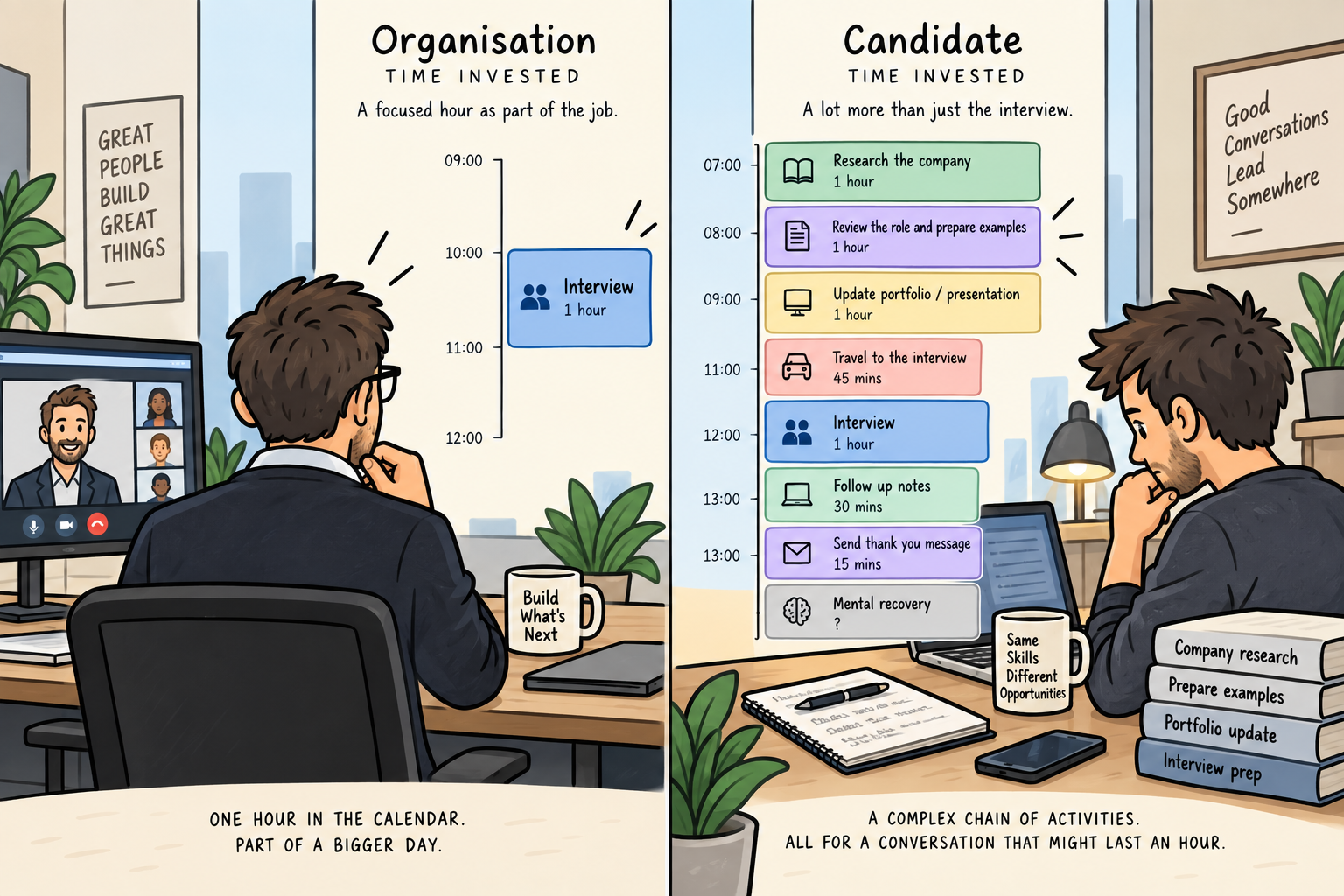
One of the patterns I've become particularly conscious of is the asymmetry around time. For everyone inside the company, recruitment happens during working hours. The recruiter is being paid while conducting the screening call, the hiring manager is being paid while interviewing candidates, and everyone sitting on an interview panel is participating in the process as part of their job.
For the candidate, that same process is usually happening on their own time. More importantly, a one-hour interview doesn't necessarily cost a candidate one hour. They may have spent time researching the company, reading about the product, preparing examples, updating a portfolio or presentation, completing an exercise, rearranging meetings, taking time away from their existing job, travelling somewhere or organising childcare. Even without any of those practical costs, there's still the mental investment involved in preparing for a conversation that might determine where they spend a substantial part of their life for the next few years.
None of that appears in the calendar invitation.
This is where I think hiring processes can become unintentionally one-sided. Candidates are quite reasonably expected to respect the company's time by arriving prepared, responding promptly, meeting deadlines and taking interviews seriously, but I'm not convinced the process always recognises that the candidate's time deserves exactly the same consideration. That becomes particularly important when circumstances change.
Perhaps the role itself changes. Perhaps the budget changes. Perhaps the company is already very advanced with another candidate. Perhaps something happens internally that dramatically reduces the probability of the process continuing. That doesn't necessarily mean every interview should immediately be cancelled, because hiring is uncertain and companies understandably need alternatives until someone has actually accepted an offer, but if the information would materially affect whether a candidate believes investing another few hours is worthwhile, I think there's a reasonable argument that they should know it.
Not because the company owes them a better chance of getting the job, but because it's their time being invested and they should have enough information to decide what they want to do with it. Transparency gives them agency.
Maybe the funnel is part of the problem
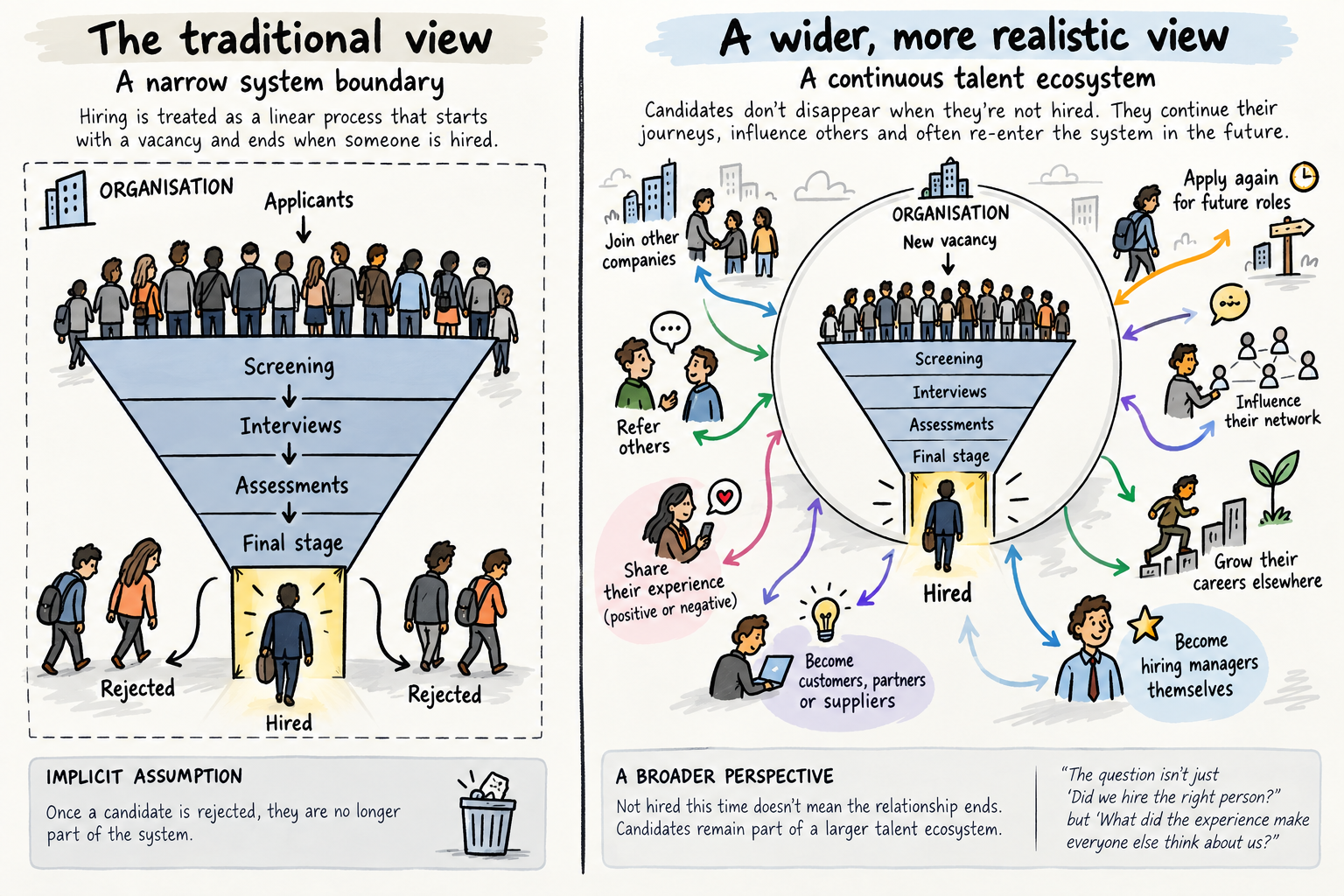
The language we use around recruitment is revealing. We talk about a hiring funnel because, operationally, that's exactly what it is. Lots of people enter at the top and the number gets progressively smaller until one person eventually emerges at the bottom. It's a useful model for managing recruitment, but I'm not sure it's a particularly good model for understanding the relationship between a company and the people applying to work there.
A funnel implies that once something leaves it, it no longer matters.
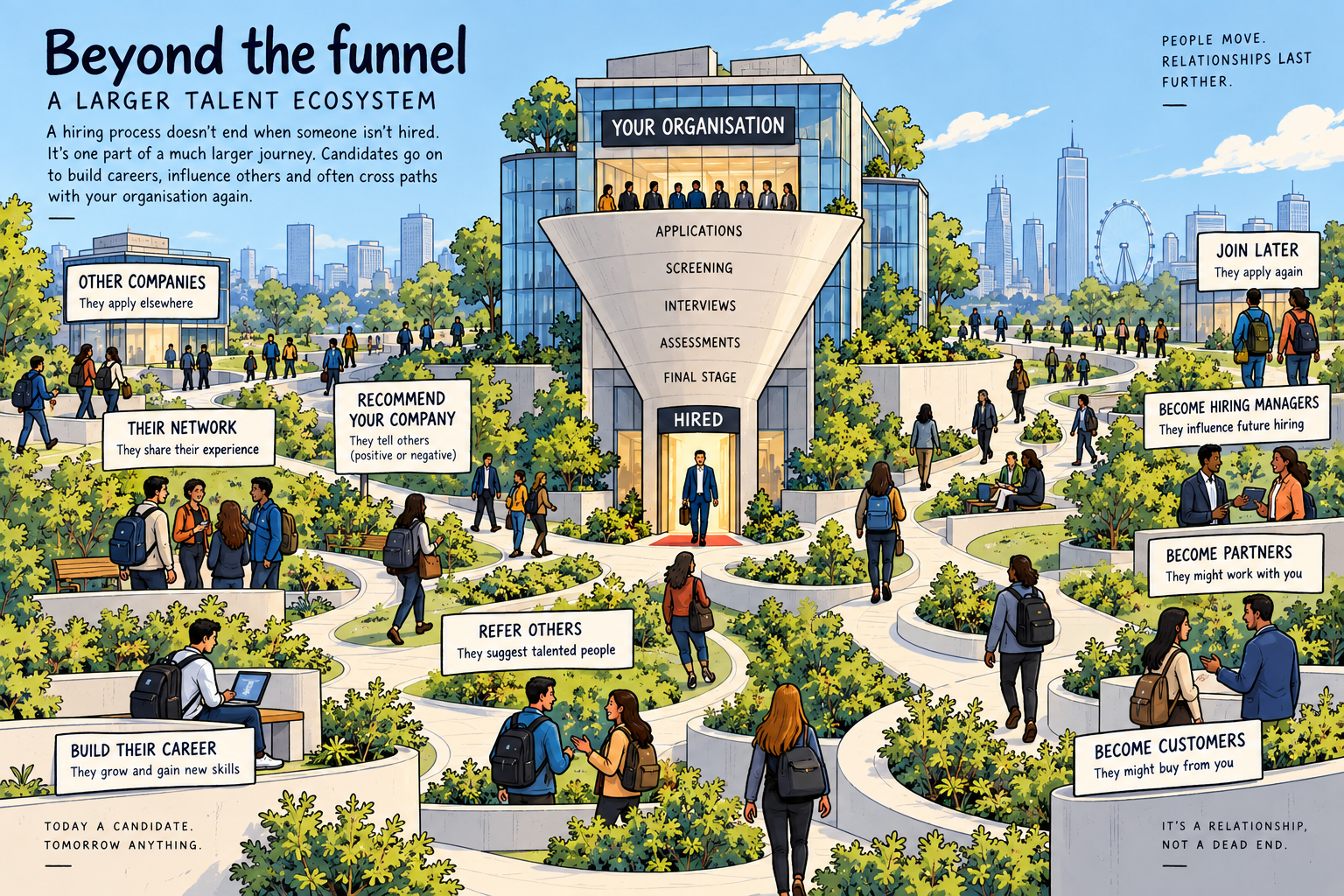
People don't disappear when they're rejected. They continue their careers, move between companies, talk to colleagues, recommend jobs to friends, become hiring managers themselves and occasionally become customers, suppliers, partners or clients of the same organisations they once applied to work for. They may even become exactly the person that organisation desperately wants to hire a year or two later.
So perhaps Rejected → Closed isn't actually the right state at all.
Perhaps it's closer to:
Not hired this time → Relationship continues
That sounds like a small semantic difference, but it changes the boundary of the entire system. And I think this is where my background in screening probably affects the way I see it. Organisations naturally divide services according to their own structure. Recruitment owns one part, a hiring manager owns another, screening may be performed by another team or an external provider, HR owns something else and onboarding begins somewhere after that. Those boundaries are useful to the organisation because somebody needs to own each part of the process. But they're not necessarily meaningful to the person experiencing it.
The candidate doesn't necessarily experience a recruitment service, followed by a screening service, followed by an HR process and then an onboarding process. They experience a relationship with a company.
That's a fairly basic service-design principle, but applying it to hiring creates an interesting question:
Where does that service actually begin and end?
A vacancy ends, but hiring doesn't
Companies understandably organise recruitment around individual vacancies because that's what needs to be managed. A role opens, the company starts looking, somebody is eventually hired and the requisition is closed. The problem is that the organisation's need for people doesn't end when that particular vacancy does. Someone leaves. Someone retires. A team grows. A new product gets funded. Someone gets promoted. A new capability suddenly becomes important. Six months later another role appears and the organisation starts looking for people again.
Seen from that perspective, hiring isn't really a collection of isolated funnels. It's an ongoing relationship between an organisation and the talent market around it and if that's true, every hiring process is also influencing the next one. Suppose I interview ten strong designers for a role and eventually hire one of them. The traditional process tells me that I've successfully filled the vacancy, but from a longer-term perspective I'm also left with nine designers who now have a much more informed opinion of my company than they did before they entered the process.
If those nine people leave thinking, "I didn't get the job, but I'd happily talk to them again," I've created something useful. Some of them may apply again when another role appears. One may recommend a former colleague. Another might respond when my recruiter contacts them a year later. Someone else might simply tell a talented friend, "I've interviewed with them before. They're good people. You should apply."
Now imagine those same nine people leave thinking, "I wouldn't waste your time." I still filled the vacancy. My time-to-hire metric might look great, the successful candidate might be delighted and the recruitment dashboard might show absolutely nothing wrong. But I've also created a future cost for the organisation that is much harder to see.
Rejected candidates may be one of your largest audiences
Over time, particularly in a growing company, the number of people who meaningfully interact with the recruitment process can easily become much larger than the number of people the company actually employs. That makes recruitment one of the more interesting ways in which people experience an organisation from the outside. A job description says something about the company. So does the first email from a recruiter. So does the way an interview is scheduled, the amount of preparation requested, the way delays are communicated, the quality of the conversations, the feedback afterwards and, eventually, the rejection.
Whether the company intends it or not, all of those things contribute to its reputation as an employer and this is where I think the distinction between rejection and a bad candidate experience becomes particularly important. Someone doesn't have to be happy about being rejected in order to leave with a positive opinion of the company.
"They chose someone else, but I'd absolutely apply there again" is a perfectly possible outcome.
So is:
"They chose someone else, but I know someone who would be perfect for another role they're advertising."
Of course, plenty of rejected candidates will probably leave somewhere in the middle. They won't particularly recommend the company or criticise it. They'll simply move on. But the candidates at either end are much more interesting because they can affect the company's future talent pool. A promoter can make that pool larger. They may apply again, recommend the company to someone else, respond positively when a recruiter contacts them in the future or tell a talented friend that the company is worth talking to. A detractor can do the opposite. They may decide never to apply again, ignore future approaches or tell somebody considering a role that they wouldn't bother.
The rejection is the same in both cases.
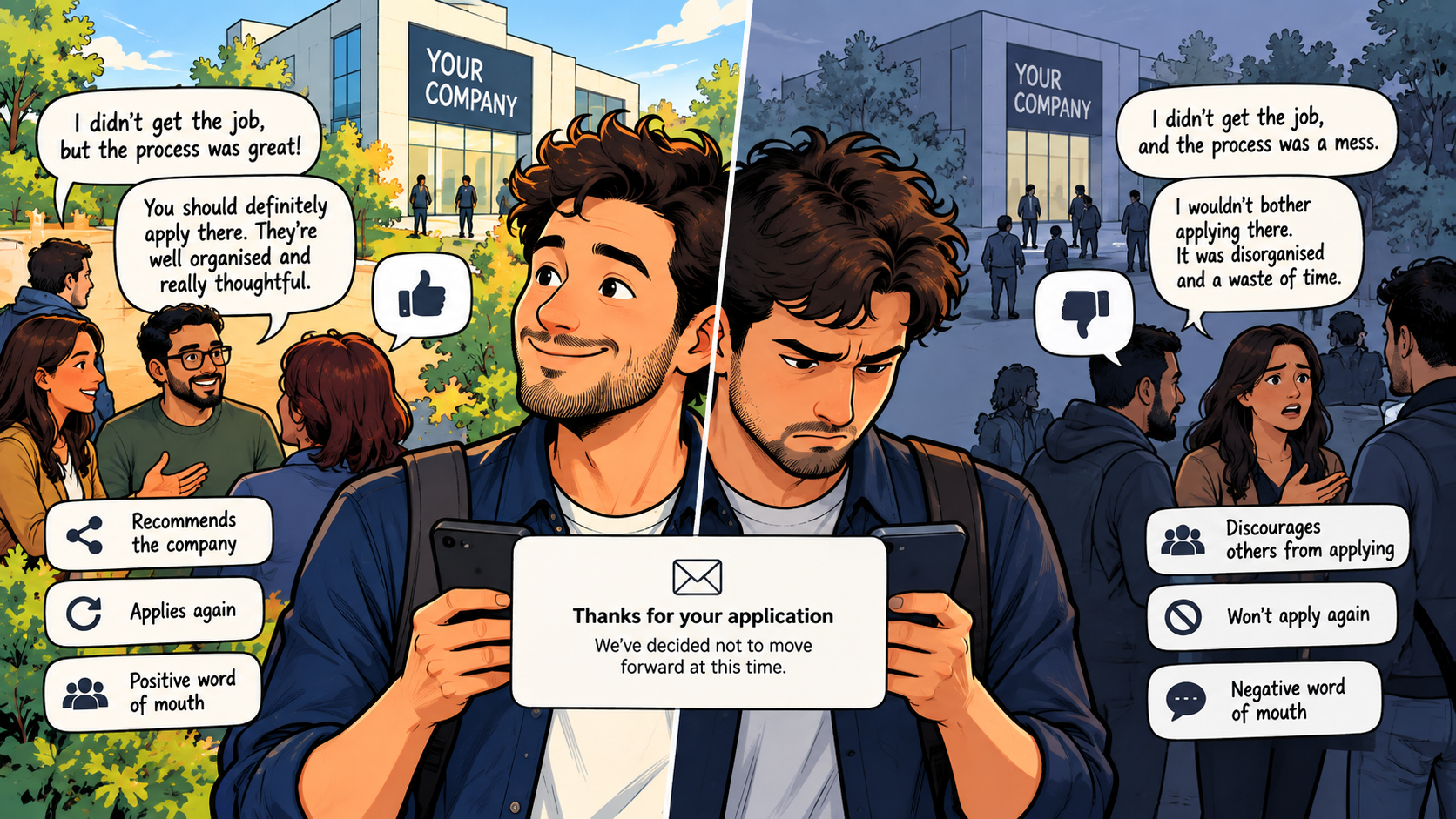
What changes is the relationship the company is left with afterwards.
And importantly, that relationship isn't determined entirely by whether the candidate got what they wanted. The hiring process itself can influence which side of that equation they eventually land on. A rejected candidate therefore isn't necessarily a failed output of the hiring process. They may actually become part of the company's future talent acquisition capability, or part of the reason that capability becomes weaker.
Perhaps we're measuring the process too early
I'm not suggesting that every applicant deserves an interview, that companies should stop processes because one candidate is disappointed, or that everyone who gets rejected should receive an hour of personalised feedback.
Hiring requires companies to make choices, and those choices necessarily mean most candidates won't get the job and that's fine. What I'm questioning is where we decide that the process has succeeded. We measure time-to-hire, cost-per-hire, offer acceptance, source effectiveness and conversion between different stages because those things help organisations understand whether their recruitment operation is functioning efficiently, but perhaps there's another question worth asking people when they leave the process:
Would you apply here again?
It's a slightly different question from asking whether they were satisfied with the recruitment experience, because somebody can be disappointed, frustrated or genuinely upset about not getting a job and still believe the process itself treated them fairly. If someone spends several hours interacting with an organisation, gets told that somebody else was chosen and still thinks, "Yes, I'd come back if the right role appeared," then something about that service probably worked. If enough people say no, I'm not convinced filling the vacancy is enough evidence that it did and there's a business reason for caring about that which goes beyond simply being nice to people.
Companies regularly complain that they struggle to find good candidates, but how many good candidates have already interacted with those companies and decided not to come back?
Every person who has previously interacted with a hiring process potentially influences the answer.
Some are future candidates themselves. Some know future candidates. Some will answer a recruiter who contacts them again and some won't. Some will recommend the company when a friend mentions a vacancy, while others will quietly say they wouldn't bother. None of those effects necessarily appears in the metrics attached to the vacancy that originally created them, yet collectively they influence the organisation's ability to attract talent in the future.
Perhaps talent acquisition doesn't begin when a vacancy opens. Perhaps some of the candidates available to you tomorrow are being created or lost by the hiring processes you're running today.
Design the exit as carefully as the destination
In service design, I wouldn't evaluate a service only by looking at the people who reached the destination I wanted them to reach. I'd also look at where people left, why they left, what happened immediately before that point and what relationship, if any, they had with the service afterwards.
Hiring feels like an interesting exception because leaving without the desired outcome isn't an unusual failure state. It's the normal outcome for almost everyone who enters the process. The person you eventually hire obviously matters enormously, and finding that person is the reason the process exists in the first place, but they're still only one of the people who experienced it. Everyone else leaves with an impression of the company, and that impression doesn't disappear when their application is moved to "rejected" in an ATS.
Some will apply again. Some will recommend someone else. Some will tell their network they had a surprisingly good experience despite not getting the job. Others will decide they don't want to interact with that company again. I don't pretend to know what the perfect hiring process looks like, and I'm certainly not suggesting that every rejected candidate needs a personalised experience or that companies should make recruitment slower and more complicated in an attempt to keep everyone happy.
Hiring is already difficult enough, and rejection will always be part of it, water is still wet, but I do wonder whether we're drawing the boundary of the system in the wrong place. If we think of hiring as a process that begins when a vacancy opens and ends when someone accepts the offer, then optimising around the successful candidate makes complete sense. If instead we think of hiring as an ongoing relationship between an organisation and the talent market around it, perhaps the people we reject aren't simply unsuccessful outputs of the process. Perhaps they're still participants in a much longer service and if that's the case, maybe the interesting question isn't simply whether your hiring process found the right person this time.
Maybe it's also worth asking:
What did the process make everyone else think about you?
Would they apply again? Would they recommend your company to someone they know? Would they answer the next time one of your recruiters contacts them? Or would they tell a friend not to bother?
I don't know what the right metric for that is, or even whether it can be reduced to a useful metric at all. But I suspect there's something worth examining here, because companies spend enormous amounts of effort building their employer brand while simultaneously putting far more people through recruitment than they will ever employ, so I'm curious how other people see it, particularly recruiters, hiring managers, service designers and anyone who's spent enough time on the candidate side of the table.
Are we designing hiring around the person who gets the job when perhaps we should be learning more from everyone who doesn't?
Keep reading
More articles
Governance & Scale
The Components Are the Least Important Part of a Design System
A design system is more than a collection of reusable components. It’s the shared set of principles, relationships, decisions, and practices that help teams create consistent, accessible, and adaptable products.
Read · 5 minDesign Systems
Build a Design System That Can Survive You
What world building taught me about making design systems self-sufficient.
Read · 12 minCollaboration & Alignment
When experience makes us faster, how do we slow down without losing momentum?
Experience helps us recognise problems and solutions faster. But speed can also make us confident in the answer before we’ve confirmed we’re solving the right problem.
Read · 11 min