AI-Enabled Design Operations
Who Trains the Seniors When AI Replaces the Juniors?
AI can replace much of the work we once gave juniors. But if companies stop investing in the people who become tomorrow’s experts, what happens when today’s experienced talent is gone?
Andrei Stanescu

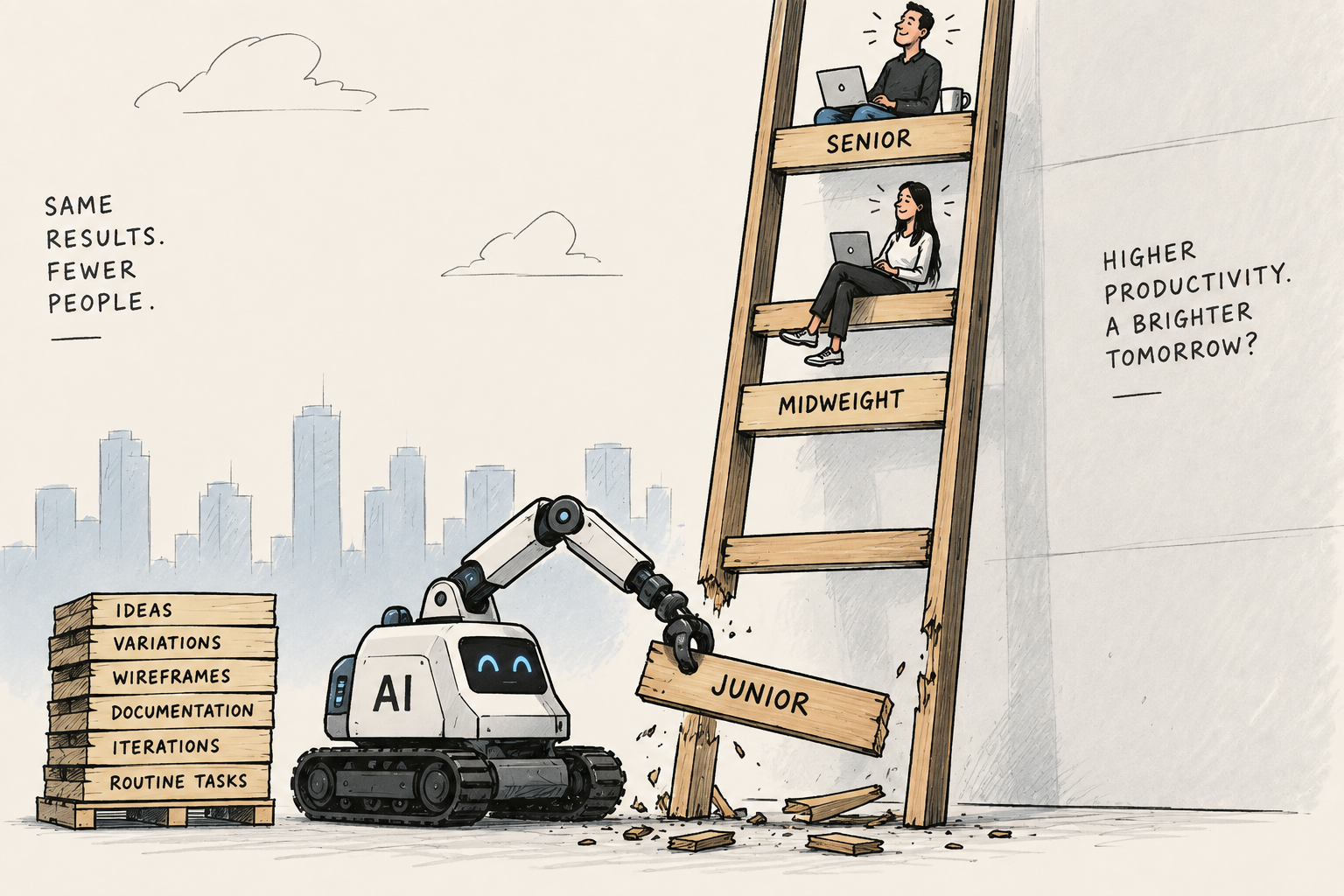
AI can already do a surprising amount of the work we used to give junior designers. Give it a brief and it can generate concepts, explore directions, create interface variations, critique a flow, write documentation and help turn an idea into something tangible remarkably quickly.
Not necessarily better, but exponentially faster.
That distinction matters, because AI doesn't have to be better than a junior designer for the economics to start looking attractive. A junior might spend a day exploring several directions while AI can generate dozens in minutes. Many of them might be mediocre and some might be completely wrong, but if you put those outputs in front of someone experienced enough to recognise what is useful, what is nonsense and what deserves further exploration, you suddenly have a very productive combination.
And that creates an uncomfortable question for companies: if AI can already do a significant amount of the work we used to hire junior designers to do, why hire the junior?
It's not an unreasonable question. Juniors are an investment. They need mentoring, reviews and explanations. They make mistakes, and someone more experienced has to spend time helping them understand those mistakes when they could otherwise be doing their own work. Then, after several years of that investment, just as the junior becomes genuinely valuable, they might leave. Another company might end up hiring the designer you spent years helping to develop.
AI doesn't do that, so the idea of letting AI handle more of the junior-level work while concentrating your hiring budget on people who already have the experience you need can make perfect sense for an individual company. The problem starts when everyone reaches the same conclusion.
Everyone wants experienced people
Look through enough job descriptions and you'll find some variation of the same requirement everywhere: experience.
Companies want designers who can operate independently, navigate ambiguity, challenge assumptions, understand technical constraints, make difficult trade-offs and recognise when something that looks perfectly reasonable is actually solving the wrong problem. If anything, I think AI makes those people more valuable rather than less.
Generating something is becoming increasingly easy. Understanding whether that thing should have been generated in the first place, whether it solves the right problem and whether the compromises behind it make sense is still much harder. So there is an obvious model emerging: hire experienced people and give them AI to make them dramatically more productive. There is just one problem with that model that I don't think we're talking about enough.
Where are all those experienced people supposed to come from?
Nobody starts their career as a Senior Product Designer. The experienced designers companies are competing for today were once inexperienced designers somebody decided were worth taking a chance on.
They misunderstood briefs, designed things that didn't work, defended decisions they later realised were wrong and encountered constraints they hadn't considered. They watched users behave completely differently from what they expected, had engineers explain why something couldn't be built the way they imagined it, and sat through conversations where a seemingly obvious decision became much more complicated once business reality entered the room.
More importantly, they usually had someone more experienced around who could help them understand what had happened. Over time, all of those experiences accumulated into what we eventually started calling seniority. The title came with it, but the title was never the important part. The judgement was.
We can still promote people, but that doesn't automatically give them experience
This is where I think the conversation about AI replacing junior jobs risks missing the more interesting problem.
People will still progress through titles. Someone can spend a couple of years as a Junior Designer, become a Midweight Designer and eventually be promoted to Senior Designer. Their salary will increase, their responsibilities will change and their LinkedIn profile will show perfectly normal career progression.
But if AI increasingly performs the work through which previous generations developed their judgement, we should probably ask whether those people are accumulating the same depth of experience along the way.
Five years of employment doesn't automatically equal five years of meaningful experience.
Humans develop judgement by experiencing things, getting some of them wrong, having assumptions challenged and seeing what happens after decisions leave the comfortable environment in which they were made.
That is why I don't think the real danger is that one day we'll wake up and discover there are no Senior Designers left. There could be plenty of people with Senior Designer in their title.
The more uncomfortable possibility is that seniority gradually becomes disconnected from the experience we expect someone at that level to have.
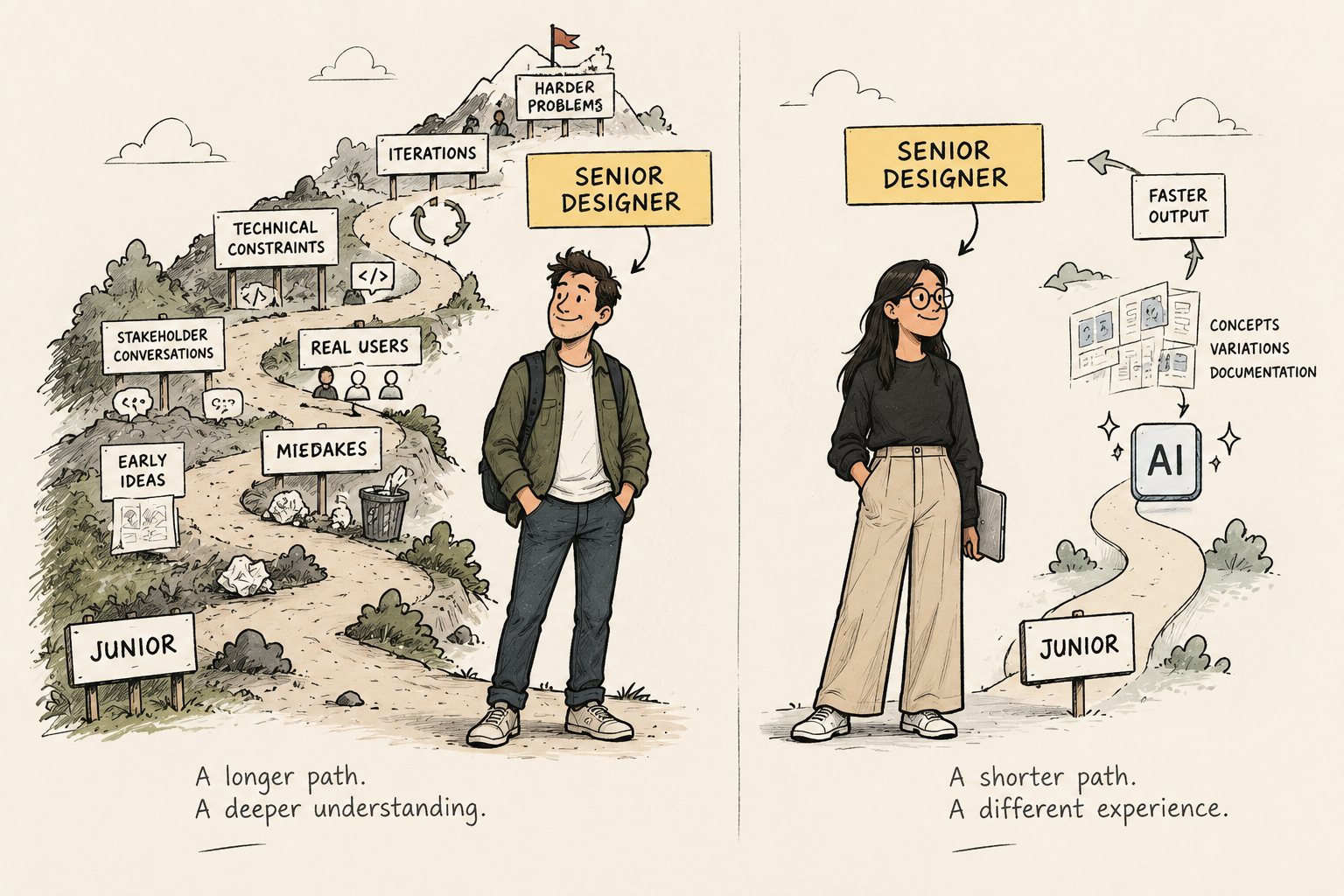
This is where the circle starts
AI reduces the immediate need for junior-level output, which makes it easier for companies to hire fewer juniors. Fewer juniors then receive meaningful opportunities to develop, which means fewer of them become genuinely capable midweights and, eventually, genuinely experienced seniors.
As experienced talent becomes scarcer, companies have even more reason to compete for the people who already have that experience while relying increasingly on AI for everything underneath them. That, in turn, makes hiring juniors look even less attractive and around we go. The problem isn't simply that AI might replace junior designers. It's that AI makes it incredibly easy to stop investing in the people who would eventually become the experienced designers companies still expect to hire later. The strange thing is that, right now, the model can look like it's working extremely well.
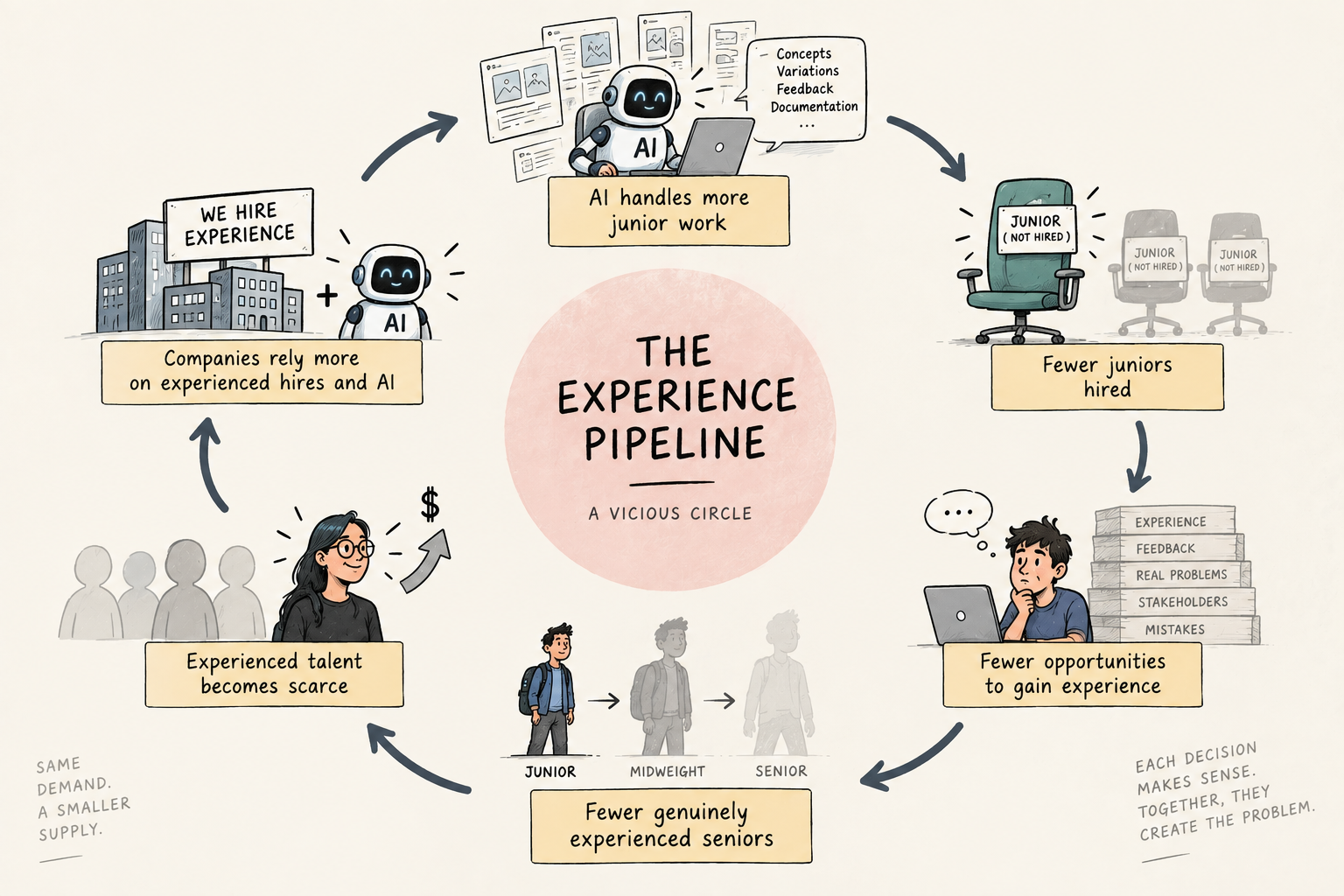
We already have the experienced people
Look around established organisations today and there are experienced designers everywhere: seniors, leads, principals, heads of design and directors.
Give those people AI and, unsurprisingly, they can become enormously productive. They already have the judgement necessary to decide what to ask for, recognise when an answer is wrong, understand what needs further exploration and know when something that appears convincing shouldn't be trusted, but most of those people developed that judgement in a world where they actually had to do much of the work AI now does for them. They spent years solving problems themselves, making mistakes themselves and gradually building the mental models that allow them to use AI effectively now.
AI didn't create that expertise. It arrived after the expertise had already been created. That's an important distinction, because companies can look at an experienced designer using AI today and conclude that the combination is proof that they don't need as many inexperienced people anymore. What they're actually looking at is the result of years of human development combined with a new tool that makes that already-developed human more capable. We're benefiting from an experienced workforce created under one model while potentially dismantling the model that created it.
For a surprisingly long time, that might work perfectly well, which is exactly why I think the risk is easy to miss.
Experience debt
The closest analogy I can think of is debt.
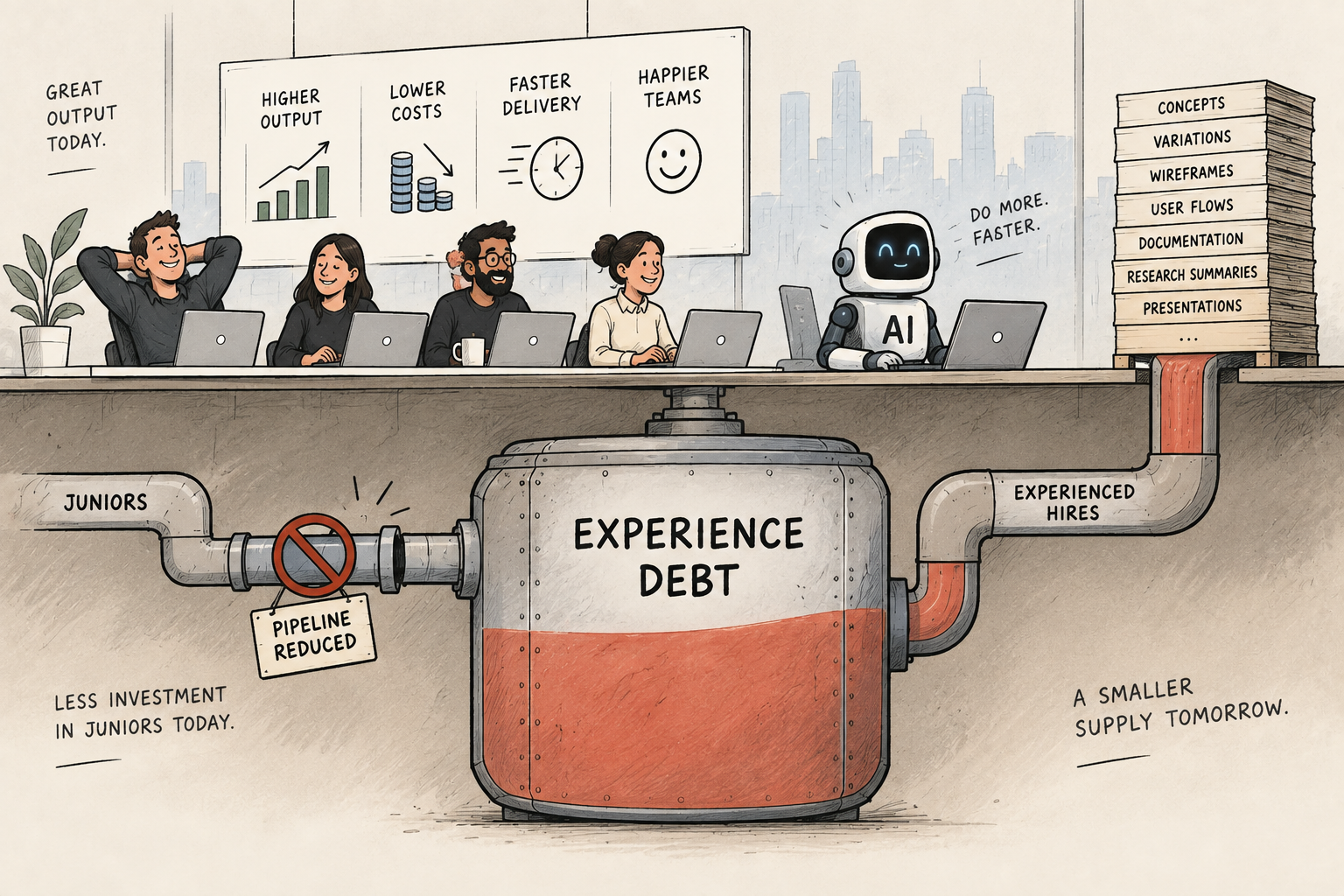
When a company decides not to hire a junior, the benefits can appear immediately. There is less mentoring required, experienced designers can spend more time producing, AI handles more of the execution and the organisation may be able to achieve the same or greater output with fewer people.
The cost doesn't appear alongside those benefits. The junior you don't hire today isn't a missing senior tomorrow. They're potentially a missing senior five, eight or ten years from now. Multiply that decision across hundreds or thousands of companies and eventually you have fewer people reaching the levels of experience everyone still expects to be able to hire.
I think of that as experience debt because, like most forms of debt, it can feel like free efficiency while you're accumulating it. The consequences arrive later, and often long after the people who made the original decision have moved on. The problem is that once the bill arrives, experience is unusually difficult to manufacture quickly. You can open another vacancy. You can increase the salary. You can hire recruiters and search internationally.
What you can't do is decide on Monday that you need ten years of accumulated judgement by Friday.
Why should a company train someone for its competitor?
There is a very reasonable objection to all of this, and I don't think the argument works if we pretend it doesn't exist.
Why should a company spend years developing someone who might leave as soon as they become genuinely valuable?
The company pays for the mentoring. Its experienced employees spend time teaching rather than producing. It absorbs the mistakes that inevitably come with learning and gives someone progressively more difficult opportunities so they can develop. Then another company offers them a better role or more money and they leave. From the original company's perspective, it can look as though it paid for someone else's experienced hire. That is a genuine risk, and I don't think companies should be criticised for recognising it.
The problem is that hiring experienced people instead of training inexperienced ones only works while somebody else is still willing to do the training.
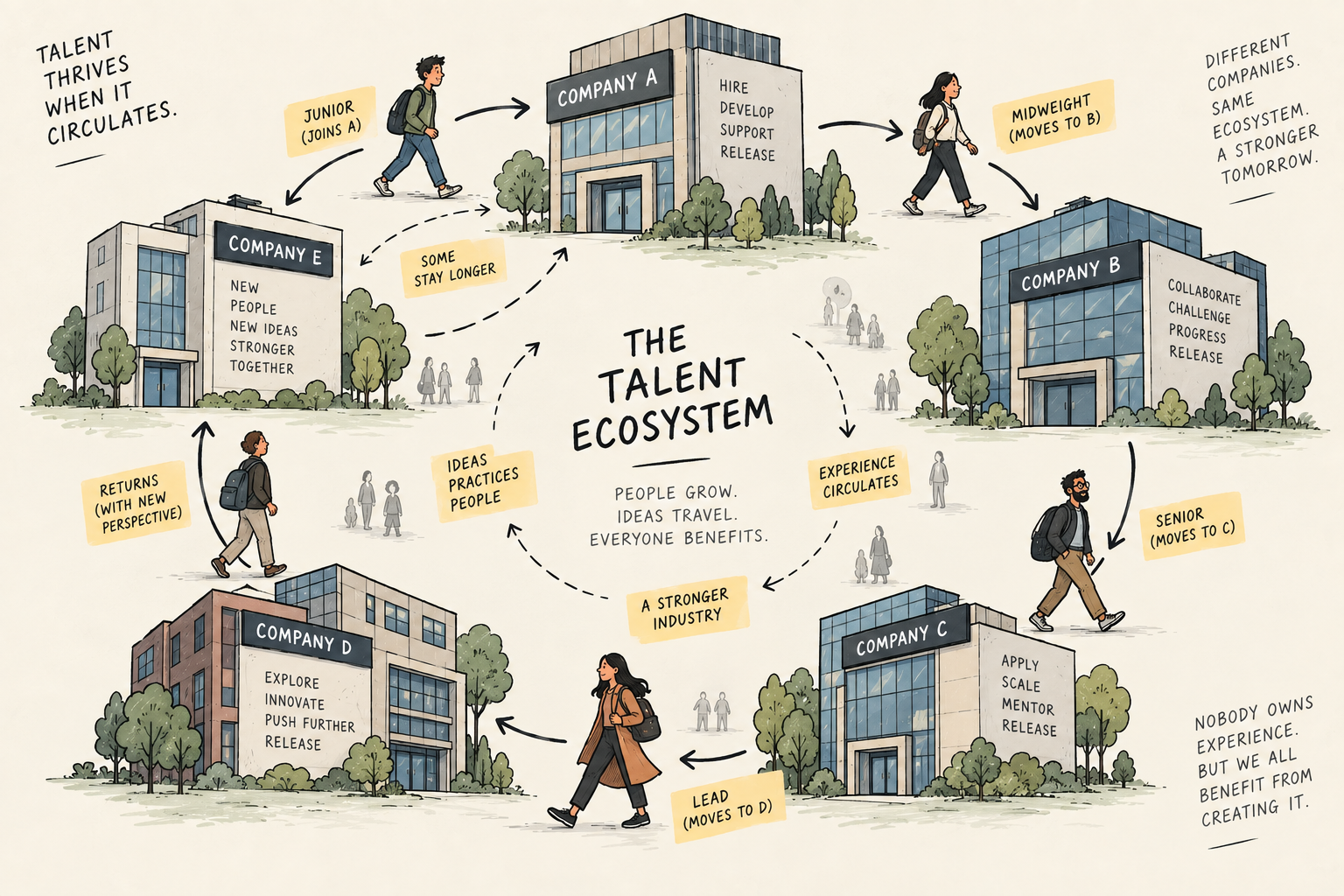
If Company A develops people who eventually join Company B, while Company B develops people who later join Companies C and D, and some of those people eventually find their way back to Company A, no organisation captures the entire return on every person it develops. But all of them benefit from participating in an industry that continuously creates experienced people.
Now imagine Company A decides it no longer needs to participate. AI can do much of the junior work, so it saves the development cost and hires experienced people when it needs them. That can be a very sensible decision. Then Company B notices the same thing and reaches the same conclusion. Eventually C and D do as well. None of those companies has necessarily made a bad decision when viewed individually, but collectively they have created a problem because everyone still expects experienced people to be available while fewer organisations are willing to participate in creating them. In other words, everyone wants seniors, but increasingly nobody wants to pay for the years in which they become senior.
There may also be value in being one of the companies that still does
There is another side to the risk of developing people that I think is worth considering.
As fewer organisations become willing to invest seriously in inexperienced people, the ones that continue doing it become unusual. That doesn't mean everyone they train will stay. They won't, and pretending otherwise would make the argument much weaker. People leave companies for all sorts of perfectly legitimate reasons: money, progression, interesting work, management, location or simply wanting something different, but I do think there is a meaningful difference between joining a company because it recognised the value you already had and remembering the company that saw potential in you before that value was obvious to everyone else.
Some of those people will stay longer. Some will leave and eventually return. Others may recommend former colleagues, refer candidates or carry that relationship with them as they move through their careers and some will simply leave and never come back. That's part of the risk, but companies also hire experienced people somebody else invested in. Experience has always moved around the labour market rather than remaining permanently with the organisation that helped create it.
The junior you train today might eventually become somebody else's senior.
But the junior nobody trains today never becomes anyone's senior.
I don't think the answer is preserving junior work
None of this means we should deliberately keep humans doing work AI can perform faster simply because that's how previous generations learned. If AI can generate twenty variations in the time it takes a designer to create three, use it. If it can automate tedious production work, automate it. Making someone spend three days doing something AI can accomplish in twenty minutes isn't necessarily professional development.
We shouldn't preserve inefficiency and call it training.
What we need to preserve is the path through which inexperienced people become experienced and that may mean the traditional junior role itself needs to change. Instead of spending a day producing several variations, perhaps a junior uses AI to generate twenty and spends their time understanding why nineteen of them shouldn't be used. Perhaps we expose them to harder problems earlier because AI gives them the ability to explore those problems without requiring the production skills previous generations first had to develop. They can critique AI output, participate in stakeholder conversations, experience engineering constraints and see what happens when a design that made perfect sense in Figma encounters an actual user. Most importantly, they still need opportunities to make decisions themselves and occasionally get those decisions wrong while someone with more experience is there to help them understand why.
Used that way, AI could potentially help the next generation develop faster than the previous one did, but that requires companies to see junior development as something worth investing in even when they no longer need juniors to produce the same volume of junior-level output.
Maybe we're asking the wrong question
When companies look at what AI can already do, it's understandable to ask whether they still need a junior designer to perform a particular task. In many cases, the answer may genuinely be no, but junior work and junior designers aren't the same thing. So instead of asking whether we still need someone inexperienced to perform work AI can already do, perhaps the more important question is how someone becomes capable of doing the senior work if we remove the opportunities through which they used to gain experience. The experienced people making AI so powerful today won't be around forever. Some will retire, some will move into leadership, some will change careers and others will simply stop doing the work directly. Eventually another generation has to replace them.
AI may solve much of our need for junior-level output, but it doesn't remove the need to create senior-level expertise.
And if enough companies decide that developing inexperienced people is somebody else's problem, we may eventually discover that the biggest talent problem AI created wasn't that it took people's jobs. It was that we became so efficient at avoiding inexperienced people that, eventually, we stopped producing experienced ones. So if AI increasingly does the work we used to give juniors, how do we make sure the juniors of today still get the experience we expect from the seniors of tomorrow?
I don't think the answer is to slow down AI or artificially preserve work that no longer needs to be done. But I do think we need an answer because if every company plans to hire experienced people rather than create them, eventually we're all hiring from the same shrinking pool.
And I'm genuinely curious:
Who do we expect to replenish it?
Keep reading
More articles
Governance & Scale
The Components Are the Least Important Part of a Design System
A design system is more than a collection of reusable components. It’s the shared set of principles, relationships, decisions, and practices that help teams create consistent, accessible, and adaptable products.
Read · 5 minCollaboration & Alignment
What am I actually fixing?
It's easy to get caught up in designing solutions before fully understanding the problem. I've been developing a framework for ConScept to help avoid unnecessary work, overlooked assumptions and overcomplicated solutions by asking better questions before making decisions.
Read · 12 minAI-Enabled Design Operations
Claude vs. Codex? I Think We're Asking the Wrong Question
After building the same website with Claude and Codex, I stopped asking which one was better. Both can design, both can code, but they bring very different instincts to the work. Maybe choosing an AI is less about capability, and more about choosing the right collaborator for the task at hand.
Read · 9 min