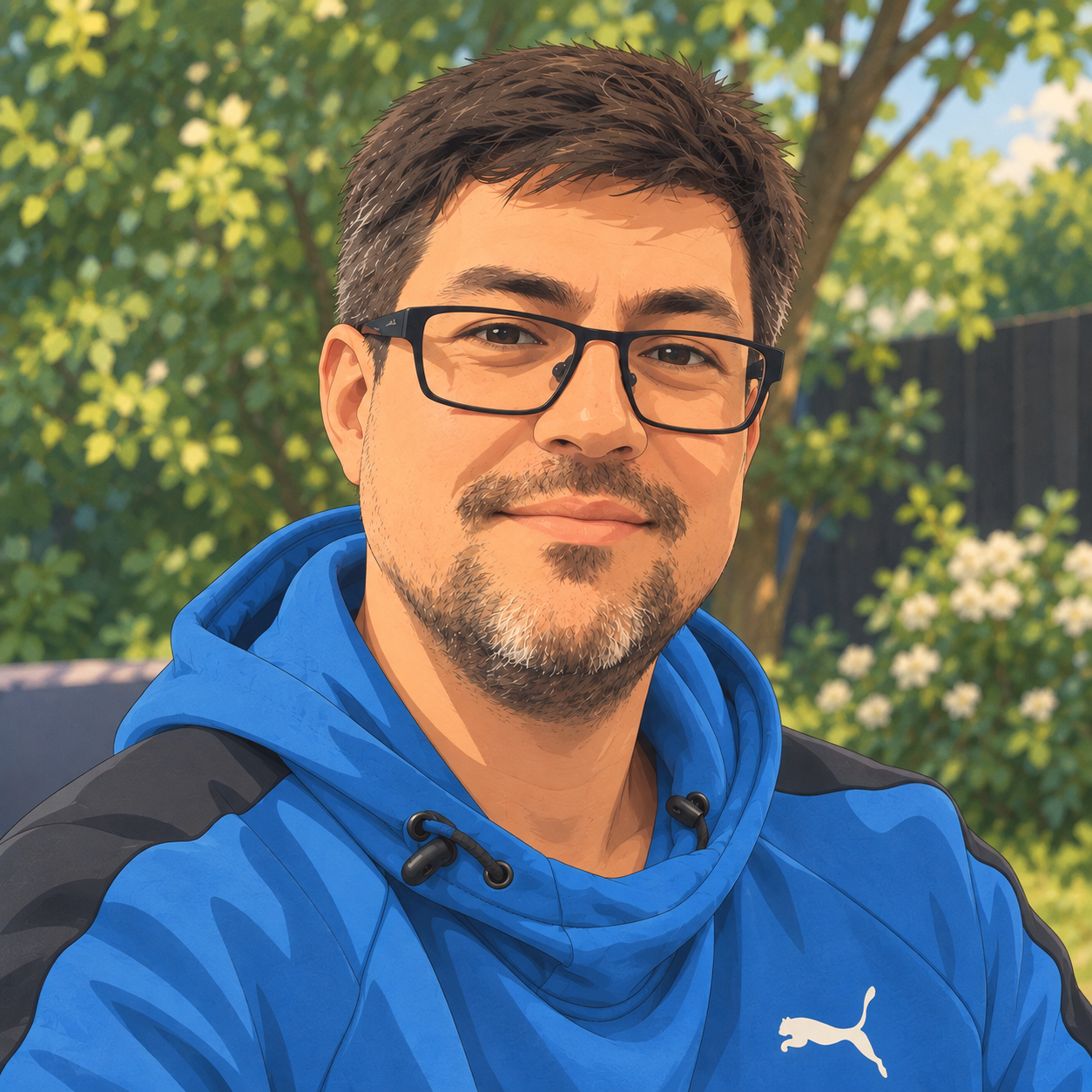
I've been thinking about creativity lately.
Not creativity as a professional skill. Not “how do I come up with better ideas at work?”, but rather something a little more fundamental: What happens to your creativity when you spend too long being good at one thing?
As a product designer, I spend a lot of my time solving problems inside constraints. Users, business goals, technology, accessibility, design systems, deadlines, stakeholders, and I want to be very clear about it: I love that. (maybe someday I will work up the courage to be more specific about what I did to get here, but for now let's just stay at: my parents did not like it one bit.)
But there is a strange side effect to becoming experienced at something: you also become experienced at knowing what good looks like. You know the patterns. You know the conventions. You know what will work and sometimes I wonder if that makes it harder to surprise yourself.
So I decided to go somewhere completely different: I started writing a book.
I've actually been doing this for a very long time
The funny thing is, world-building and storytelling aren't new interests for me and if you really think about it, they are not so different from the work we do as product designers.
I remember doing this in high school: A friend and I would sit on a bench in a park and spend ridiculous amounts of time debating stories.
I'd have an idea about how something should work -> He'd disagree -> I'd explain why my version made more sense -> He'd come back with a completely different interpretation.
Then we'd start exploring the consequences of each version.
What if this happened instead? What would this character do? Why would they make that decision? What would happen twenty years later?
We weren't writing anything. We weren't trying to publish anything. We were just building worlds because it was fun.
And looking back, I think that was probably one of the purest forms of creative collaboration I've experienced.
There was no deliverable. No audience. No career benefit. Neither of us had any intention to become writers. Just two kids who were studying (drum-roll....) design, trying to figure out which version of an imaginary world made more sense.
I hadn't thought about those conversations in many years. Then I started working with Claude and suddenly, that feeling came back.
I wanted to see how far I could push an AI creatively
I have a Claude subscription (and I think it is something that shouldn't surprise anyone in today's ecosystem).
Like a lot of people, I'd mostly thought about AI in terms of productivity: helping with writing, thinking through problems, generating ideas, summarizing things, making the boring parts of work faster.
But I'd been wondering about something else: How far could I push it creatively?
Not to design something. Not to generate a presentation. I wanted to see what would happen if I used it to help me create something that had absolutely nothing to do with my professional work.
So I gave it the broadest version of the world I'd been imagining. Not a complete story. Not a detailed plot. Just the world as I saw it.
And before we went any further, I gave Claude one very specific instruction: Don't make decisions for me. If something is missing, ask me.
That instruction ended up defining the entire process and what brought back that feeling of creativity and collaboration.
“What about this?”
Claude started asking questions. Lots of them.
What caused this? Why would this character do that? What happened before this?What does this person actually want? What are they afraid of? What would happen if this decision had consequences twenty years later?
Sometimes I had the answer. Sometimes I didn't and when I didn't, we explored it.
This was probably the closest I'd come to recreating those conversations on the park bench all those years ago. Except this time, I had an endlessly patient conversation partner who could remember an increasingly ridiculous amount of detail.
The important part was that Claude wasn't deciding what the world should be. It was helping me discover what I thought the world should be.
That distinction became incredibly important. I would give it an idea. It would find the interesting questions hidden inside that idea.
I'd answer. That answer would create another question. I'd answer that one. And gradually, the world became much richer than the version I'd started with.
Not because Claude invented it for me. Because it kept making me think about it.
Suddenly, I wasn't writing a book
I was building a world.
We started developing the history behind the story. Then the characters. Not just their names and appearances, but the things that make people interesting:
What drives them.
What they want.
What they fear.
What makes them angry.
What makes them happy.
How they respond under pressure.
Where they repeatedly fail.
What they believe about themselves.
What they believe about other people.
And, perhaps most importantly, what they don't understand about themselves.
We mapped relationships between characters. We worked through events that happened before the story began. Then events during the story. Then consequences that wouldn't happen until much later.
We defined major events for individual characters and how those events intersected with everyone else's lives. and because of the fun of the creative process, I was able to generate chains of events that would span for centuries inside the world.
Eventually, we had enough history and unresolved threads to comfortably support five books, and potentially many more.

Images generated by ChatGPT based on the world bible I have been developing with Claude
And this is where something clicked for me.
I wasn't simply writing a story. I was creating a system of relationships, motivations, history and consequences.
As a designer, that way of thinking felt strangely familiar.
The design system I never intended to build
Today, a significant part of my professional work involves design systems.
I've spent a lot of time thinking about foundations: the underlying structures, rules and relationships that allow something larger to work consistently.
I ended up doing something remarkably similar with a fictional universe.
Except there were no components. There were characters.
There were no design tokens. There were motivations, beliefs and history.
There were no interaction patterns. There were relationships.
And there was one very important difference. The system could change. In fact, it had to.
Canon is just another word for “things I previously decided”
One of the most useful things Claude did was keep me honest.
I'd establish something about a character. Then, several chapters later, I'd write something that contradicted it. Claude would point it out.
You're deviating from the established canon.
And then I'd have to make a decision. Was I making a mistake? Or had I just discovered a better version of the story?
Sometimes I went back and fixed what I'd written. Sometimes I changed the canon. That distinction became really important to me. The goal wasn't consistency for consistency's sake.
The goal was to preserve the integrity of the world unless I'd discovered something better.
So Claude became something between a creative collaborator and a continuity editor. It could remember decisions I'd made. It could challenge me when I contradicted them. It could show me the consequences. For those who will choose to read the book, Claude was my "arguing box" (and I will leave it at that to create some desire for reading)
But Claude couldn't decide which version I preferred. That was still my job and I think that's one of the more interesting things about AI-assisted creativity.
The machine can generate possibilities. It can question your assumptions. It can remember an enormous amount of context. But someone still has to decide what belongs.
Then I wanted to see the world
Once the world had become detailed enough, I started feeding parts of the bible into ChatGPT.
I'd take a scene or location we'd described and ask it to generate an image. And sometimes the results were genuinely good. Not “good for AI.” Just good.
There were moments where I looked at an image and thought:
Yes. That's what this place looks like.
Or:
That's exactly how I imagined these people standing in that room.

Image generated by ChatGPT based on the world bible description of one of the most important cities in my story

Image generated by Chat GPT based on the world bible description of a highly pivotal scene in the series (which I will not describe so that I don't provide spoilers)
Of course, some were completely wrong. But even that was useful, because suddenly I could see what I didn't mean.
No, the building wouldn't look like that. That isn't how this character would dress. The atmosphere should be different. The scene should feel more oppressive. The character should be further away.
Again, the AI wasn't replacing my imagination, it was giving my imagination something to react to.
And that became another form of creative conversation.
A few weeks later, I had a book
The amount of material grew surprisingly quickly.
At the moment, the project contains:
6 pages of major timeline events covering seven major characters.
33 pages of character bible covering nine important characters, including the seven major characters.
A few dozen pages of general world bible covering events and decisions that should never necessarily appear on the page—but influence everything that does.
And the first book.
Written. Refined. Proofread. With a cover.
And a few appendices explaining details that might not be immediately obvious.

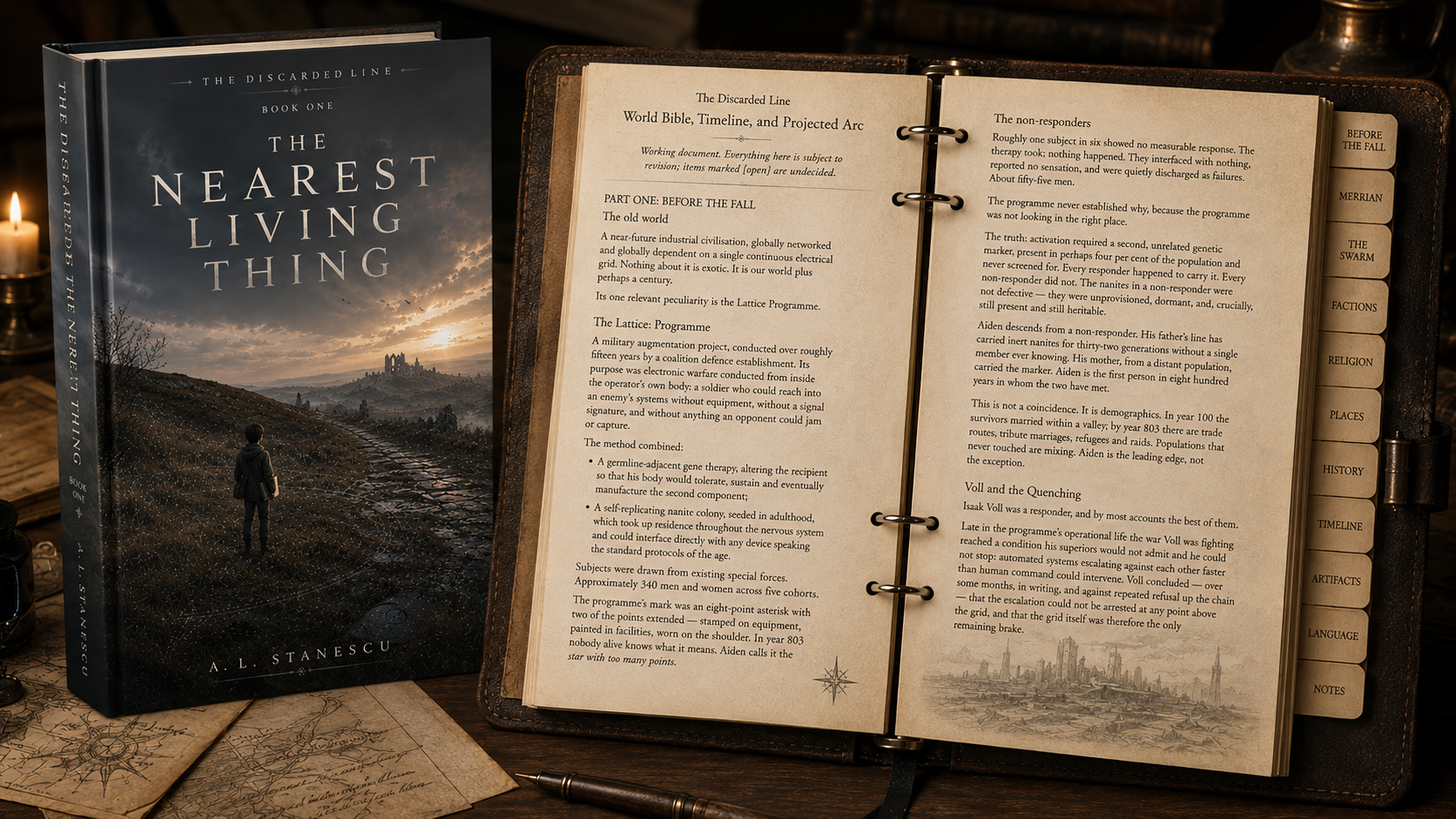
Book cover and a small snippet of the world bible
I spent most of those few weeks actually writing. And rewriting. And then writing again. And occasionally being told that I'd broken my own story.
That part was probably the most time-consuming. Not because Claude was writing the book for me. Because it was constantly giving me another question to answer.
AI made the process faster. It didn't make the decisions easier.
This distinction matters to me. I don't think I could honestly say:
“AI wrote a book for me in a few weeks.”
It didn't. I wrote it.
What AI did was dramatically reduce the friction around exploration. I could take an idea and immediately interrogate it. I could test a character's motivation. I could explore the consequences of an event. I could learn about the plausibility of some decision I made.
I could ask what I'd forgotten. I could maintain continuity across an increasingly complicated fictional universe. I could generate names. Places. Relationships. Alternative possibilities.
And then I could reject most of them. That's the part that sometimes gets lost in conversations about AI and creativity.
Generating something is cheap. Choosing something is still hard. And choosing is where taste lives.
Maybe the point wasn't learning to write
The more I worked on the book, the more I realized that I wasn't really trying to become a writer.
I'd rediscovered something I'd enjoyed as a teenager.That feeling of sitting across from someone and saying: No, wait. What if this happened instead? Then arguing about it, then following the consequences somewhere neither of you expected.
Claude gave me a new version of that experience. It could challenge me endlessly, remember what we'd established and it could ask questions I hadn't considered.
And unlike my friend on that park bench, it never had to go home.
The technology was new, the creative instinct wasn't.
Maybe creative people need more creative disciplines, not fewer
I've started to think that maintaining creativity might actually require expanding into other creative fields.
Designers should write - Writers should draw - Developers should make music - Musicians should build things.
Not because everyone needs to become multidisciplinary professionally, but because being a beginner changes the way you approach problems.
You stop relying on expertise. You become curious again. You notice things. You make mistakes. You discover that the assumptions you brought from your primary discipline don't necessarily apply and sometimes you bring something unexpected back with you.
That's what happened to me. I went into this thinking I was experimenting with AI-assisted writing. Instead, I came out thinking differently about creativity itself.
So... was it worth it?
Absolutely.
I'm still refining the first book. The world is still evolving. The canon occasionally changes and I'm currently working on the second book.
I don't know where the series will ultimately end up. I don't even know if I'll ever print it but I now have something I didn't have before: an entire world that exists because I decided to make it.
And that's a pretty good reminder that creativity doesn't always have to serve your career. Sometimes you should make something simply because you want to know whether you can.

A scene described in Book one
And if you're curious about what came out of this experiment, I'm happy to share it.
The book was never printed, so I only have a digital copy. If you'd like to read it, send me a message and I'll happily send you a copy.
And if you enjoy it and want to know what happens next, I'm already working on book two. Maybe that's the best part of becoming a beginner again.
You don't know where you're going. You just keep making things until you find out.